GitLab Inc. (GTLB) – The Governance Layer of the Agentic Economy
The Third Great Transition

Go read this first: https://the-razors-edge.ghost.io/razors-edge-giga-long-gitlab-time/

1. Executive Thesis
In five decades of observing the capital markets, one learns to distinguish between cyclical hype and structural dislocation. We have witnessed the migration from the centralised mainframe to the distributed client-server architecture in the 1990s, and subsequently, the seismic shift from on-premise infrastructure to the cloud in the 2010s. We are now standing at the precipice of the third great transition: the evolution from human-centric software development to the Agentic AI Economy.
The market’s current trepidation regarding GitLab Inc. (GTLB), manifested in a volatile reaction to its Q3 FY2026 guidance, reflects a fundamental misunderstanding of this transition. The prevailing narrative, often characterised as “Death by Devin,” posits that autonomous AI coding agents will render the seat-based licensing models of DevOps platforms obsolete. If software writes itself, who pays for the developer seats?
This report argues the opposite. The commoditisation of code generation via “vibe coding” tools like Cursor and Devin does not diminish the value of the DevOps platform; rather, it exponentially increases the necessity for a rigorous, auditable, and secure Governance Layer. As the marginal cost of creating code approaches zero, the marginal cost of verifying, securing, and managing that code becomes the primary value driver in the enterprise stack. GitLab is not merely a tool for humans; it is becoming the regulatory framework for agents.
Our analysis validates the core tenets of the “Razor’s Edge Giga Long” thesis. The industrialisation of software development by AI agents creates an “Identity Arbitrage” where the consumption of security and governance features (monetised via GitLab’s Ultimate tier) outpaces the compression of human headcounts. Furthermore, the inherent security risks of “Shadow AI”, unmanaged agents operating in local environments, will force Chief Information Officers (CIOs) to retreat into the safety of FedRAMP-authorised, closed-loop platforms like GitLab.
Trading at approximately 7x trailing sales, GitLab presents a valuation disconnect reminiscent of Adobe’s transition to the cloud or Microsoft’s pivot to Azure. We are witnessing the metamorphosis of a developer tool into critical enterprise infrastructure, the “Infrastructure of Truth” for the AI era.
2. The Agentic Paradox
To comprehend the investment case for GitLab, one must first rigorously critique the thesis which challenges the bearish consensus on AI displacement. The thesis postulates an “Agentic Reversal,” suggesting that the integration of AI agents will catalyse a net expansion in GitLab’s revenue through pricing leverage and identity management, rather than a contraction through seat loss.
2.1 The “Death by Devin” Fallacy
The bearish narrative relies on a linear extrapolation: if an AI agent like Cognition AI’s “Devin” can autonomously act as a software engineer, enterprise engineering teams will shrink. A department of 100 developers might reduce to 10 architects managing a swarm of bots. In a strictly seat-based model, this implies a catastrophic 90% revenue churn for platforms like GitLab.
However, this view suffers from the Lump of Labour Fallacy. History demonstrates that when technology reduces the cost of production, demand for the output increases disproportionately (Jevons Paradox). In the 1990s, Visual Basic and IDEs made coding easier, yet we employ more developers today than ever before. The “AI Paradox” survey data confirms this: 76% of respondents believe that as coding becomes easier with AI, the demand for engineers will actually increase to manage the sprawling complexity of AI-generated systems. The bottleneck shifts from writing code to reviewing, securing, and orchestrating it.
2.2 Critique of Assumption: Agents Need Identities
The “Razor’s Edge” thesis asserts that replacing human engineers does not eliminate the license; it merely changes the licensee from a human to a “Service Account”.
The Audit Imperative: In highly regulated sectors, banking, aerospace, healthcare, defence the concept of an anonymous “bot” pushing code to production is anathema to compliance. Every line of code must be attributable to a specific identity for audit trails. If a vulnerability is introduced, the system must record which agent, configured by whom, and authorised by what policy, committed the change.
The Licensing Mechanism: GitLab’s architecture enforces this via Service Accounts. These are non-human identities used for automation. Crucially, the Premium tier ($29/user/month) limits customers to a strict 1:1 ratio of Service Accounts to human seats. If a team of 10 engineers wishes to deploy 20 autonomous agents to test, document, and refactor code, they are blocked.
The Ultimate Upsell: To unlock unlimited Service Accounts, the customer must upgrade to the Ultimate tier ($99/user/month). This pricing gate serves as a structural “upsell trap.” As organizations scale their agentic workforces, they essentially “graduate” out of the Premium tier. The thesis correctly identifies that the revenue per human employee increases by roughly 3.4x (from $29 to $99) to support the agentic swarm. Even if the human headcount contracts by 50%, the revenue uplift from the tier migration results in net growth.
2.3 Critique of Assumption: Security Drives Higher Costs
The second pillar of the thesis is that AI-generated code necessitates advanced security features, driving adoption of the higher-margin Ultimate tier.
The “Vibe Coding” Risk: AI tools like Cursor and Devin prioritise velocity. They allow developers to “vibe code”—describing intent in natural language and accepting the output without deep scrutiny. Research indicates that while AI reduces syntax errors, it significantly increases the incidence of “hallucinated” dependencies, insecure patterns, and logic flaws.
The “Security Analyst” Stack: GitLab Ultimate effectively bundles the capabilities of a security analyst into the platform. It offers Vulnerability Management, Dependency Scanning, Fuzz Testing, and Compliance Frameworks. For a CIO, the calculus is straightforward: if you allow AI to write code at 100x speed, you must deploy automated security at 100x scale. Manual code review is mathematically impossible in an agentic workflow.
Mechanism of Monetisation: The thesis argues that the security features in Ultimate are no longer “nice-to-haves” but “must-haves” to mitigate the liability of AI code. Our analysis of the feature set confirms this: automated Vulnerability Resolution (where AI suggests fixes for security flaws) is exclusively gated to Ultimate. Therefore, the adoption of AI coding tools acts as a forcing function for the adoption of GitLab’s most expensive tier.
2.4 The Structural Moat: Compliance as a Product
The “Razor’s Edge” thesis holds merit because it recognises that in the enterprise, Trust is a more scarce resource than Code. By positioning itself as the “System of Record” for identity and security, GitLab monetises the governance of agents. The bear case fails to account for the fact that managing a non-deterministic, probabilistic workforce (AI agents) is inherently more expensive and complex than managing a deterministic human workforce, creating a larger, not smaller, total addressable market for governance platforms.
3. The Threat Landscape: “Vibe Coding” vs. The Iron Cage
The competitive landscape for developer tools has bifurcated into two distinct philosophies: the Velocity Maximalists (Cursor, Devin, Windsurf) and the Governance Maximalists (GitLab, GitHub Enterprise). Understanding the tension between these two camps is critical to the investment thesis.
3.1 The Rise of the “Vibe Coders”
Tools like Cursor (an AI-native fork of VS Code) and Devin (an autonomous software engineer) represent a paradigm shift in the Developer Experience (DX). They offer a “magic” capability where developers can build entire features by simply prompting the AI, often bypassing the granular file-editing process entirely.
The Allure of Velocity: For individual developers and early-stage start-ups, these tools offer unmatched speed. Cursor’s “Shadow Workspace” and “Composer” features allow for multi-file edits and context-aware generation that feels superior to traditional IDEs. The “vibe” is one of unencumbered creation.
The Shadow AI Risk: However, the rapid adoption of these tools creates a massive “Shadow AI” problem for the enterprise. “Shadow AI” refers to the unsanctioned use of AI tools that bypass corporate IT governance.
Data Exfiltration: Developers pasting proprietary code or customer PII (Personally Identifiable Information) into the chat interfaces of unmanaged tools risk leaking sensitive data to third-party model providers.
Malicious Injection: Security research has uncovered vulnerabilities in tools like Cursor. For instance, the CurXecute vulnerability demonstrated how attackers could craft malicious prompts or repositories that, when opened in Cursor, execute arbitrary commands on the developer’s machine. The lack of strict “Workspace Trust” controls in some configurations exposes enterprises to supply chain attacks via malicious MCP (Model Context Protocol) servers.
The “Works on My Machine” Syndrome: Code generated by “vibe coding” often lacks the rigour of enterprise standards. It may work in the local environment but fail in production or introduce subtle concurrency bugs that a human would catch.
3.2 GitLab’s Response: The “Iron Cage” of Governance
GitLab’s strategy is not to compete on “vibes” but to compete on Truth. It positions itself as the “Iron Cage” that contains the chaos of AI generation.
FedRAMP and The Regulatory Moat: A critical differentiator is GitLab’s FedRAMP Moderate Authorization for its “Dedicated for Government” offering.
Why This Matters: In the US public sector and the Defence Industrial Base (DIB), software tools must meet stringent federal security standards. An unmanaged tool like Devin or a standard installation of Cursor does not meet these requirements. The US Executive Order 14028 mandates a secure software supply chain, including the generation of a Software Bill of Materials (SBOM).
The Moat: GitLab automates the creation of SBOMs and enforces policy-as-code within the pipeline. If a developer uses Cursor to write code, they must push it to GitLab to get it deployed. GitLab becomes the gatekeeper that validates the “vibe code” against federal law. This effectively renders GitLab the “Adult in the Room” for CIOs terrified of AI liability.
The “One Platform” Advantage: While Cursor focuses on the Edit loop, GitLab owns the entire Lifecycle.
Integration: GitLab’s Duo Agent Platform integrates agents directly into the workflow—planning, coding, testing, securing, and deploying. An agent in GitLab is not just a text generator; it is a user with permissions, access to issue boards, and the ability to trigger CI/CD pipelines.
Context: Unlike a standalone editor that only sees the open files, GitLab’s agents have context of the entire repository history, the epic/issue hierarchy, and the production environment status. This allows for “Agentic workflows” that are far more robust than simple code completion.
3.3 Comparative Analysis: Features and Risks
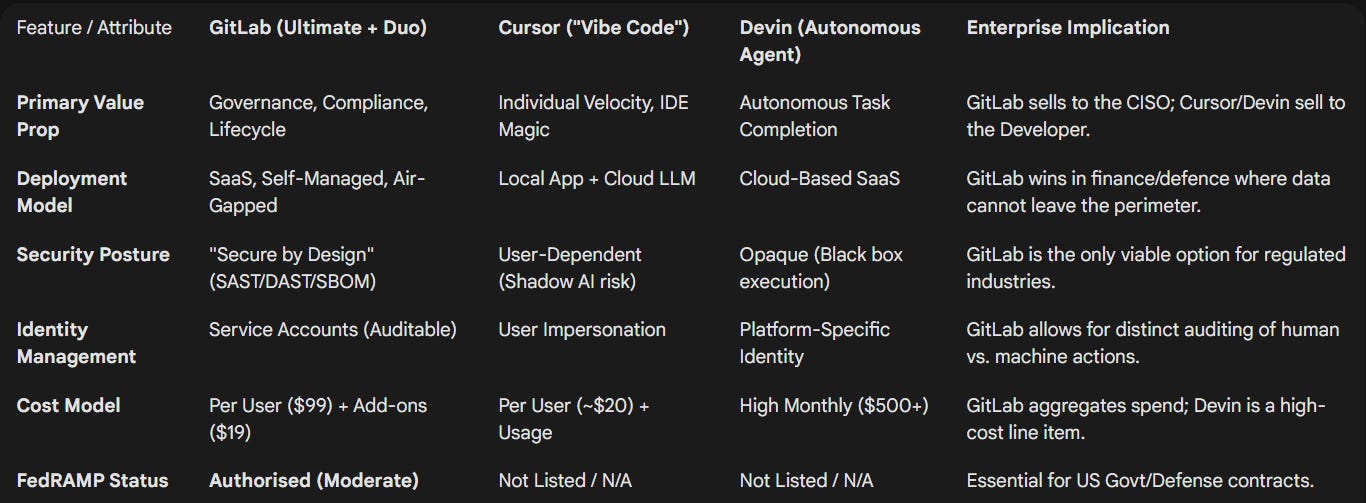
Strategic Verdict: The “Vibe Code” revolution is real, but it is a “Top of Funnel” activity. Developers may love Cursor for drafting, but the Enterprise needs GitLab for shipping. By securing the “Path to Production,” GitLab ensures that regardless of how code is written, it gets paid for managing it.
4. Financial Analysis: Resilience in Transition
GitLab’s financial performance in Fiscal Year 2026 (ended 31 October 2025) demonstrates a company successfully navigating the transition from a “growth-at-all-costs” mindset to a disciplined, profitable compounder.
4.1 Revenue and Top-Line Growth
Performance: In Q3 FY2026, GitLab reported revenue of $244.4 million, representing a 25% year-over-year increase. While this marks a deceleration from the >30% growth rates seen in previous years, it remains a robust figure for a company of its scale in a constrained macroeconomic environment where IT budgets are under scrutiny.
Forward Indicators: The Remaining Performance Obligations (RPO) grew 27% YoY to $1.0 billion. The fact that RPO growth is outpacing revenue growth is a bullish signal. It indicates that customers are committing to longer-term contracts and larger deal sizes, providing a high degree of visibility into future revenue. The cRPO (Current RPO), which represents revenue to be recognised in the next 12 months, grew 28%, further validating the near-term momentum.
Guidance: The market’s negative reaction (stock down ~8.5%) was triggered by the full-year revenue guidance of $946–$947 million, which implies a conservative outlook for Q4. Management attributed this to the shift towards a “hybrid pricing” model and macro headwinds. However, experienced observers will recognise a pattern of “sandbagging”—setting achievable targets to ensure consistent “beat and raise” cycles in future quarters.
4.2 Retention and Expansion
Net Retention Rate (NRR): The Dollar-Based Net Retention Rate stands at 119%. This metric measures the expansion of revenue from the existing customer cohort.
Interpretation: A rate of 119% is healthy, though down from the >130% highs of the pandemic era. It indicates that GitLab’s “land and expand” strategy is working—customers start with Premium and upgrade to Ultimate.
Customer Segmentation: Growth is particularly strong in the enterprise segment. The number of customers with >$100k ARR grew 23% YoY to 1,405. This confirms that GitLab is winning large, complex deployments where its governance features (Ultimate) are most valued.
4.3 Profitability and Rule of 40
GitLab has decisively silenced critics regarding its path to profitability.
Gross Margin: The Non-GAAP gross margin remains elite at 89%. This software-pure profile (minimal COGS) provides immense operating leverage. It means that for every incremental dollar of revenue, nearly 90 cents flow to covering operating expenses.
Operating Margin: The Non-GAAP operating margin expanded to 18% in Q3 FY26, a significant jump from 13% in the prior year. This demonstrates disciplined cost control, particularly in Sales & Marketing (S&M) and General & Administrative (G&A) expenses.
Free Cash Flow: Adjusted Free Cash Flow was $27.2 million (11% margin). The company has successfully transitioned from a cash-burning start-up to a cash-generating enterprise platform.
Rule of 40 Analysis:
Metric: Revenue Growth + Non-GAAP Operating Margin.
Calculation: 25% (Growth) + 18% (Margin) = 43%.
Verdict: GitLab is firmly passing the Rule of 40. In the current SaaS valuation environment, companies that pass this threshold command a premium multiple. This efficiency proves that GitLab can grow responsibly without relying on cheap capital.
4.4 Balance Sheet Strength
The company maintains a fortress balance sheet with minimal debt and significant cash reserves. This financial health is a strategic asset, allowing GitLab to potentially acquire smaller AI start-ups (to bolster its “Duo” capabilities) or weather prolonged economic downturns without diluting shareholders.
5. Pricing Strategy: The “No Rate Hike” Rate Hike
GitLab is executing a masterclass in pricing power. While the headline price per user has not technically increased, the effective price paid by enterprises is rising through a combination of tier gating, add-ons, and consumption metering. This is the “Hybrid Pricing” evolution.
5.1 The Tiered Funnel: Forcing the Upgrade
The pricing architecture is designed to funnel successful companies into the highest tier.
Free: This tier has been aggressively curtailed. It now limits groups to 5 users and offers only 400 compute minutes. It serves as a marketing tool for individual developers but is functionally useless for commercial teams.
Premium ($29/user/mo): The standard tier for most businesses. However, as noted in the thesis critique, it caps Service Accounts at a 1:1 ratio with human seats.
Ultimate ($99/user/mo): The “Enterprise” tier. It includes Unlimited Service Accounts, advanced Security Dashboards, Compliance Frameworks, and Vulnerability Management.
Strategic Lever: By placing the “Agentic Infrastructure” (Service Accounts) and “AI Safety” (Security) features exclusively in Ultimate, GitLab forces companies adopting AI to accept a 3.4x price increase (from $29 to $99) per seat. This is a massive “shadow price hike” driven by feature segmentation rather than list price adjustments.
5.2 The Hybrid Model: Monetising Consumption
Recognising that “seats” may become a less relevant metric in a distant future, GitLab is layering usage-based pricing on top of subscriptions.
Compute Minutes: AI agents run pipelines. They run tests. They compile code. All of this consumes “Compute Minutes.” GitLab charges $10 per 1,000 minutes for overages.
The Agentic Multiplier: An AI agent does not sleep. It can run thousands of tests per night. This creates a new revenue stream that scales with compute intensity, not human headcount.
Storage: $5 per month for 10GiB of storage. As AI generates more artefacts and data, storage needs grow.
Duo Add-ons:
GitLab Duo Pro ($19/user/mo): Adds Code Suggestions and Chat.
GitLab Duo Enterprise: Adds advanced features like Vulnerability Resolution and Root Cause Analysis.
Implication: A “fully loaded” Ultimate user with Duo Enterprise is paying significantly more than $99/month. The ARPU (Average Revenue Per User) expansion potential is significant.
5.3 Psychological Pricing
By keeping the base “Premium” price at $29, GitLab avoids the headline “price hike” backlash that has plagued vendors like Unity or Salesforce. The transition is subtle: “You can stay on Premium, but if you want the robots to work for you, you need Ultimate.” It frames the price increase as a value-add upgrade rather than a rent-seeking hike.
6. Valuation and Comparative Analysis
In the high-stakes world of software investing, valuation is an art of relativity. We must assess GitLab not in a vacuum, but against its peers and its own historical context.
6.1 Relative Valuation Multiples
GitLab currently trades at a discount to its “best-in-class” peers, presenting an opportunity for multiple expansion.
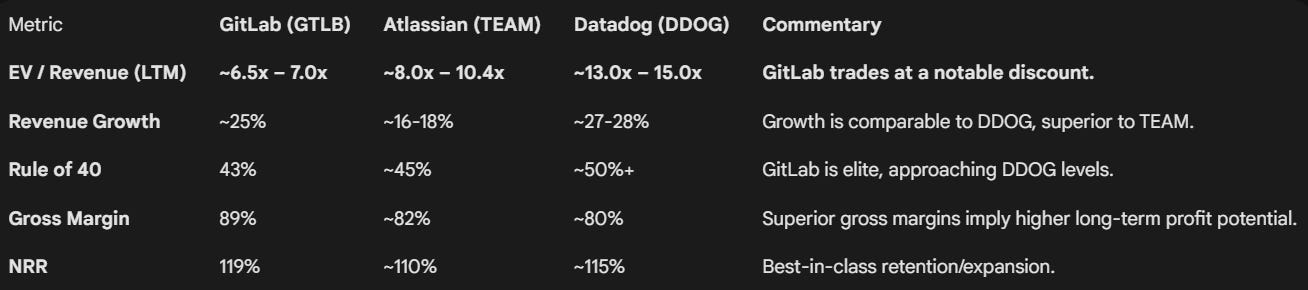
6.2 The Discount Rationale
Why is the market discounting GitLab?
The Microsoft Shadow: The existence of GitHub (backed by Microsoft/OpenAI) creates a permanent “terminal value” anxiety. Investors worry that Microsoft could bundle DevOps into Azure for free to kill competitors.
Profitability Maturity: While profitable, GitLab is earlier in its cash flow journey than Atlassian, which is a cash-generating machine.
Guidance Volatility: The recent conservative guide spooked momentum investors who prefer the consistent “beat-and-raise” cadence of Datadog.
6.3 The Bull Case for Re-rating
We believe the discount is unwarranted and that a re-rating to 8x-10x Sales is justified over the next 12-24 months.
Governance Premium: Security companies (CrowdStrike, Palo Alto) trade at higher multiples than developer tools. As GitLab proves it is a Security & Governance platform (via Ultimate/FedRAMP), it should command a “Security Premium.”
The Agentic Call Option: If the “Razor’s Edge” thesis plays out and agentic adoption drives Ultimate migration, growth could re-accelerate to >30%, forcing a massive repricing.
M&A Target: At ~7x sales, GitLab is a prime target for a hyperscaler (Google Cloud? Amazon?) or more mature and broader platform like Atlassian looking to counter Microsoft/GitHub. Its clean balance sheet and strategic position make it a “crown jewel” asset.
7. Recommendation: The Long View
7.1 Synthesis
We are witnessing a “changing of the guard” in software production. The era of the “artisan developer” is ending; the era of the “industrial software factory” is beginning. In this factory, AI agents are the workers, and GitLab is the factory floor manager.
The bearish view—that AI kills the seat model—is a first-order thinking error. Second-order thinking reveals that AI creates a chaotic, high-volume, high-risk environment where the Platform of Record becomes more, not less, valuable. CIOs will not allow “vibe coding” agents to roam free in their networks. They will demand the “Iron Cage” of GitLab’s Ultimate tier to ensure every line of code is logged, scanned, and compliant.
GitLab’s financials are robust, its pricing strategy is antifragile, and its competitive position in the high-compliance enterprise sector is defensible.
7.2 Investment Recommendation
Action: BUY
Target Allocation: Core Growth Holding (3-5% of Equity Portfolio)
Strategy:
Accumulate: Use the recent post-earnings dip (driven by conservative guidance) to build a position. The market is myopically focused on Q4 guidance while ignoring the multi-year structural tailwind of Agentic Governance.
Monitor: Key Performance Indicators (KPIs) to watch are RPO Growth (must stay >20%) and Ultimate Tier Mix (should continue to rise). Watch for any deterioration in Net Retention Rate below 115% as a warning sign.
Timeframe: 3-5 Years. This is a structural compounder play, not a quarterly trade.
7.3 Final Thought
In 1999, investors asked, “Who needs Oracle when the internet makes data free?” The answer was: everyone, because data needed structure. In 2025, investors ask, “Who needs GitLab when agents write code for free?” The answer is the same: everyone, because agents need governance. Buy the governance.
Disclaimers: This report is for informational purposes only and does not constitute financial advice. All investment involves risk, including the loss of principal.